
How many restrooms does a county fair need?
Start with attendance, then work backward. OSHA 1926.51(c) sets the baseline ratio for workers on a jobsite, but a fair crowd behaves differently than a construction crew: people cluster near food booths, grandstands and midway gates, so restrooms need to follow the crowd, not just hit a number. Most fair organizers in this range end up mixing standard porta potty rental units with a couple of deluxe flushable porta potty units near VIP or sponsor areas. Every cluster of single-user units needs at least one accessible unit under ADA Standards section 213.2, and that unit needs a 60 inch turning circle inside per ADA Standards section 304.3.1, plus a door opening of at least 32 inches per ADA Standards section 404.2.3. If your fairgrounds sit near Fruitridge Pocket, 8.1 miles east of West Sacramento, or draw crowds from Lemon Hill, 9.3 miles southeast, we route trucks around fair-week traffic ahead of delivery day. Use the how many porta potties do I need guide to run your own numbers before you call, or lean on our request a quote form and we will size it with you. Multi-day fairs also do better with a mid-run service pass instead of waiting until teardown, since ANSI/PSAI Z4.3 sets a baseline of one service visit per week for lighter use, and fair traffic runs well past that.
What restroom setup works best for a multi-day fair?
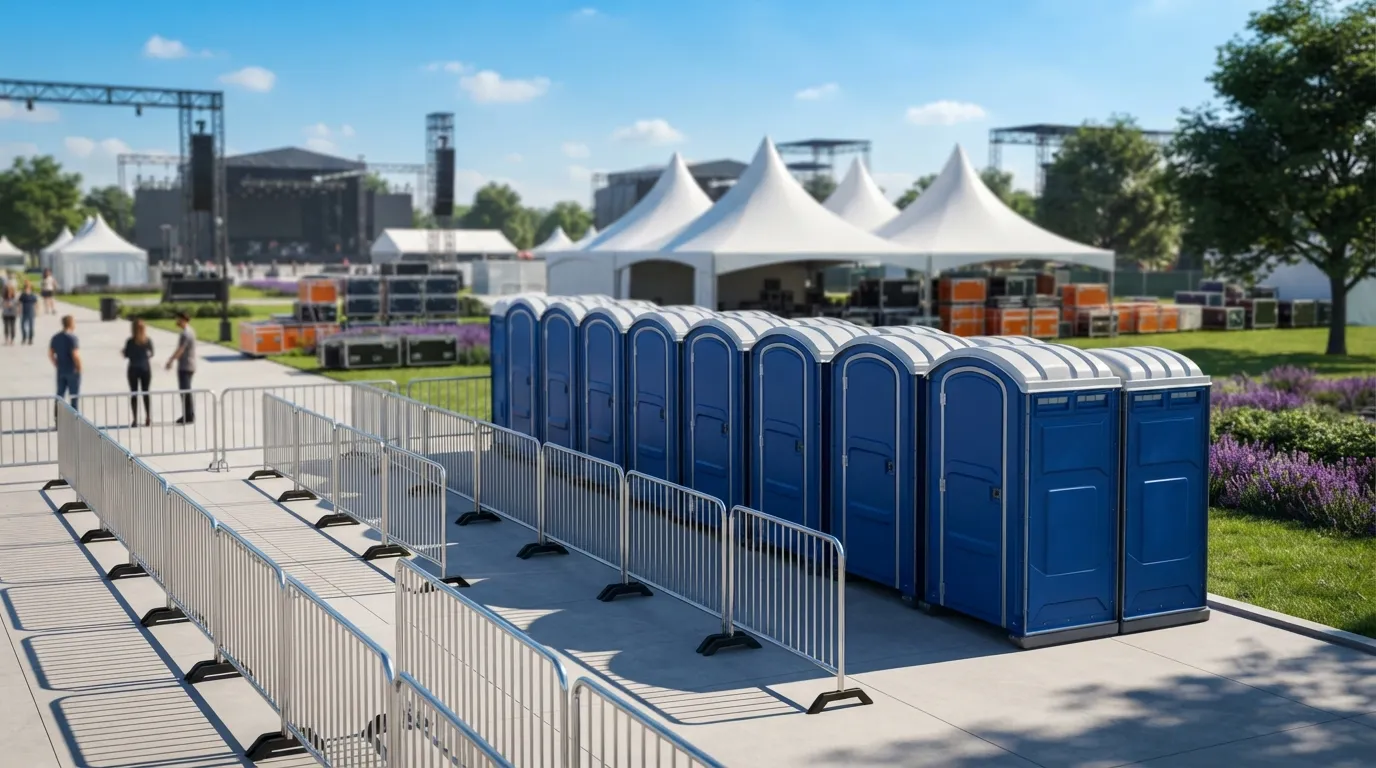
Layer it. Put standard units at the perimeter near parking, place your ADA units on a stable, slip-resistant surface per ADA Standards section 302.1, and hold a restroom trailer rental back for grandstand or sponsor areas where people expect something closer to a real bathroom. A 4 stall restroom trailer handles steady mid-day lines without backing up the midway, while an 8 stall restroom trailer fits grandstand crowds better on a headline night. Each standard unit carries a 60 to 70 gallon holding tank and stands about 92 inches tall, footprint roughly 44 by 48 inches on the ground, so spacing them along a fence line or between booths rarely eats usable vendor space. Access paths matter more than people expect: keep a clear route at least 36 inches wide per ADA Standards section 403.5.1 running from the midway to every restroom cluster, especially where cabling or fencing narrows the path. If your event runs food vendors doing any painting or coating work on booth setups, OSHA 1926.51(f)(1) requires washing facilities for that specific work, separate from general fairgoer sanitation. Pair your restroom layout with temporary fence rental to keep queues orderly, and add crowd control barrier rental near stage areas where lines tend to bunch up. For vendor booths running deep fryers or grills, a grease trap pumping plan matters too, since a grease interceptor needs pumping once fats, oils, grease and solids hit 25 percent of liquid depth.
Why do fairgrounds need handwashing stations separate from toilets?
Because food vendors trigger a different rule than the toilets do. 29 CFR 1910.141(d)(2) requires washing facilities stocked with soap and towels or a hand-drying device, not just hand sanitizer, and that requirement sits apart from your toilet count under OSHA 1926.51(c). A fair with food trucks, funnel cake stands and a beer garden needs handwashing station rental units placed at each food cluster, not just clustered near the restrooms. A portable sink rental works well for vendor rows that need refillable water rather than a fixed line. West Sacramento fairs drawing crowds from as far as Parkway, 10.9 miles southeast, or Freeport, 11.3 miles south, often run two-day or weekend formats, and a weekend rate on standard units runs cheaper per day than booking single days back to back. Review the handwashing station requirements page before finalizing vendor placements. If your fair includes an agricultural or 4-H barn component, note that OSHA 1928.110 sets a separate field sanitation standard for hand-labor work, one facility per 20 workers within a quarter mile walk, which matters if animal handlers or barn crews are on payroll rather than volunteering.
| unit | duration | low | typical | high |
|---|---|---|---|---|
| standard | event | 200 | 400 | 800 |
| ada | weekend | 199 | 240 | 300 |
| trailer | event | 2499 | 3500 | 3899 |
| deluxe | week | 150 | 250 | 290 |
Check the porta potty rental cost page for day-rate comparisons, and see restroom trailer rental cost if you're weighing trailer against standard units for a bigger footprint fair.
How far in advance should I book fair restrooms?
Book as soon as your date and attendance estimate are set, ideally 60 to 90 days out for a weekend fair. Fair season books trucks fast across West Sacramento and nearby towns. Waiting until two weeks out limits unit selection, especially for ADA units and restroom trailers.
Can I mix standard units and a restroom trailer at the same fair?
Yes, and most multi-day fairs do exactly that. Standard units cover perimeter and parking areas cheaply, while a trailer serves grandstand or VIP zones. Confirm your ADA ratio still holds under ADA Standards section 213.2 across the whole layout, not just one cluster.
Do fairgrounds need a permit for portable restroom placement?
Placement in a public right of way needs confirming with the city; this has not been verified for West Sacramento specifically. Check the porta potty permit requirements page and confirm with West Sacramento before finalizing your site map.
How often are units serviced during a multi-day fair?
ANSI/PSAI Z4.3 sets a baseline of one weekly service visit for lighter use, but fair-week traffic usually needs a mid-run pass. See how often are porta potties cleaned for what a service visit actually includes.
What lighting do I need near restrooms for an evening fair?
OSHA 1926.56(a) sets minimum illumination levels by area type for work zones, and fairgrounds benefit from the same logic after dark. Pair restroom clusters with a light tower rental so pathways and ADA units stay visible once the midway lights come up.
Next step
Get a delivery date
Tell us the address, the dates and the headcount. We size the order and confirm the route.